How to tell whether a Hot Wheels model is collectible — a friendly, practical guide 🚗🔍
Want to know if that little car in your attic is worth keeping (or selling)? Here’s an easy, scannable guide to the key things collectors look for — written so you can skim the checklist or read the short explanations. 👍
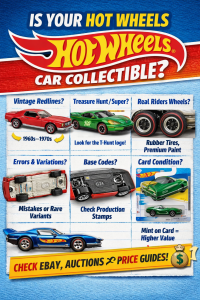
Quick checklist (TL;DR)
- Age/era (vintage = higher interest)
- Special series (Treasure Hunt / Super Treasure Hunt)
- Unique features (Real Riders wheels, Spectraflame paint, card logos)
- Errors & rare variations (misprints, wrong wheels, base errors)
- Condition & packaging (mint card = much higher value)
- Provenance / market demand (auction results, completed sales)
1) Age & era — older often = more desirable
Vintage Hot Wheels from the original Redline era (late 1960s → mid-1970s) are the ones that regularly command the highest prices among collectors. Look for the classic red rings on the tires and base dates — those are clear indicators of an early release.
2) Limited series: Treasure Hunts & Super Treasure Hunts
Since 1995 Mattel has produced Treasure Hunts (T-Hunts) and the rarer Super Treasure Hunts — cars intentionally produced in smaller quantities or finished with premium features (special paint, “Real Riders” rubber wheels, Spectraflame finishes). These are produced and signposted by Mattel and are actively collected; Super Treasure Hunts are usually the harder-to-find, higher-value subset. If a blister or car has a T-Hunt mark or the gold/special logo (or premium wheels), that’s a red flag to collectors.
3) Special features that matter
Inspect the model for:
- Real Riders (rubber tyres)
- Spectraflame or specialty metallic paint
- Premium tampo/decals or photo-etched details
- Limited-edition packaging (store exclusives, RLC sets)
These features often move a car from “cute” to “collectible.” Mattel sometimes sells complete Super Treasure Hunt sets or RLC exclusives — those product signals matter.
4) Variations & manufacturing errors — sometimes valuable
Errors (wrong wheels, missing tampo, off-center paint, unusual base codes) and rare factory variations can be collectible — but value depends on how unusual and how documented the error is. Some modern errors have little market value; others (especially on vintage pieces) can be sought after. If you think you’ve found an error, photograph it and research with specialist guides or collector communities.
5) Base codes, date stamps & production marks — clues to origin
Check the metal base for production codes and plant marks — they tell you when and where the car was made. Modern Hot Wheels use base codes that collectors decode to confirm a casting’s authenticity and production window; that info helps narrow rarity and variant identification.
6) Condition & packaging — the price multiplier
Condition is king. A mint car in its original, undamaged blister card is almost always worth far more than an identical loose model. Look for intact blister plastic, sharp card corners, and unbent backing cards. For vintage purchases, original store displays or unopened boxes dramatically increase value.
7) Market demand & proven sales — where to check price
- eBay completed listings are the practical starting point for estimating value.
- Specialist auctions or toy auction houses show what serious buyers will pay.
- Collector forums, Facebook groups, and price guides help identify rare variants. Remember: sticker price ≠ what it will sell for — final sale data matters most.
8) How to research a potential collectible (step-by-step)
- Photograph car and packaging (base, card back, close-ups).
- Read base codes and note any logos/marks.
- Search completed eBay listings for exact casting + color + card type.
- Ask the community (Reddit r/HotWheels, specialist Facebook groups, fandom pages) — collectors often spot rare traits quickly.
- Consult specialist guides for redlines and vintage models (online redline guides are excellent starting places).
9) Realistic expectations (a quick reality check)
- Most modern mainline Hot Wheels are not worth large sums; many new T-Hunts are found in the wild and sell for small premiums.
- A few vintage redlines or extremely rare errors can fetch thousands — but those are the exception, not the rule.
Quick checklist you can print
- Redline? → older & check base date
- T-Hunt / Super? → check card logo, wheels, paint
- Real Riders / Spectraflame? → premium features = higher interest
- Error / variant? → document and research
- Card condition? → mint card = value multiplier
- Provenance? → auction/completed sale data = true value